
March 19, 2026
Why E-commerce Brands Lose the Most Revenue During Their Biggest Sales
TL;DR Prepurchase questions spike during sale periods — exactly when buying intent is highest and teams are at capacity. Every unanswered question during a p...
TL;DR
- Pre-purchase questions spike during sale periods — exactly when buying intent is highest and teams are at capacity.
- Every unanswered question during a peak period is a cart that doesn’t convert.
- WISMO queries flood support in the 48 hours after every sale event — a second volume wave teams rarely plan for.
- SpeedGrowth handles both waves automatically: pre-purchase questions and post-purchase WISMO, at any volume.
- Brands that deploy before their next peak period don’t revisit the problem after it.
The biggest sale of the year is also the biggest support crisis of the year. That’s not a coincidence — it’s a structural problem that every e-commerce brand runs into, and most don’t solve before it costs them.
Peak periods concentrate two things at once: the highest buying intent your customers will ever have, and the highest volume of questions your team will ever face. Those two things are in direct conflict. When the questions don’t get answered, the carts don’t convert. The revenue loss isn’t visible in real time. You see the sale numbers. You don’t see the questions that went unanswered, the customers who waited and moved on, the carts that sat at 90% and never checked out. By the time the period is over, the gap has already closed — in the wrong direction.
The two volume waves every e-commerce brand faces during a sale
The first wave hits before the sale ends. Customers in buying mode ask the questions that stand between them and a purchase: Does this come in my size? Will it arrive before the weekend? What’s your return policy if it doesn’t fit? These aren’t edge cases — they’re the questions that determine whether a cart converts or gets abandoned.
This wave is predictable. It scales directly with traffic. The bigger the sale, the more questions arrive. The problem is that the same factors that drive traffic — promotional spend, discount depth, urgency — also accelerate the questions. Customers who are ready to buy right now don’t want to wait for an answer. They want to confirm the detail that’s stopping them, and they want to confirm it before the moment passes. The second wave arrives after the sale ends. WISMO — where is my order — floods support teams in the 48 hours following any significant sale event. Customers who bought during the period track their orders obsessively. Shipping delays compound it. Every order that doesn’t arrive on the stated date generates a contact. Teams that were already stretched handling pre-purchase volume are now handling post-purchase volume on top of it.
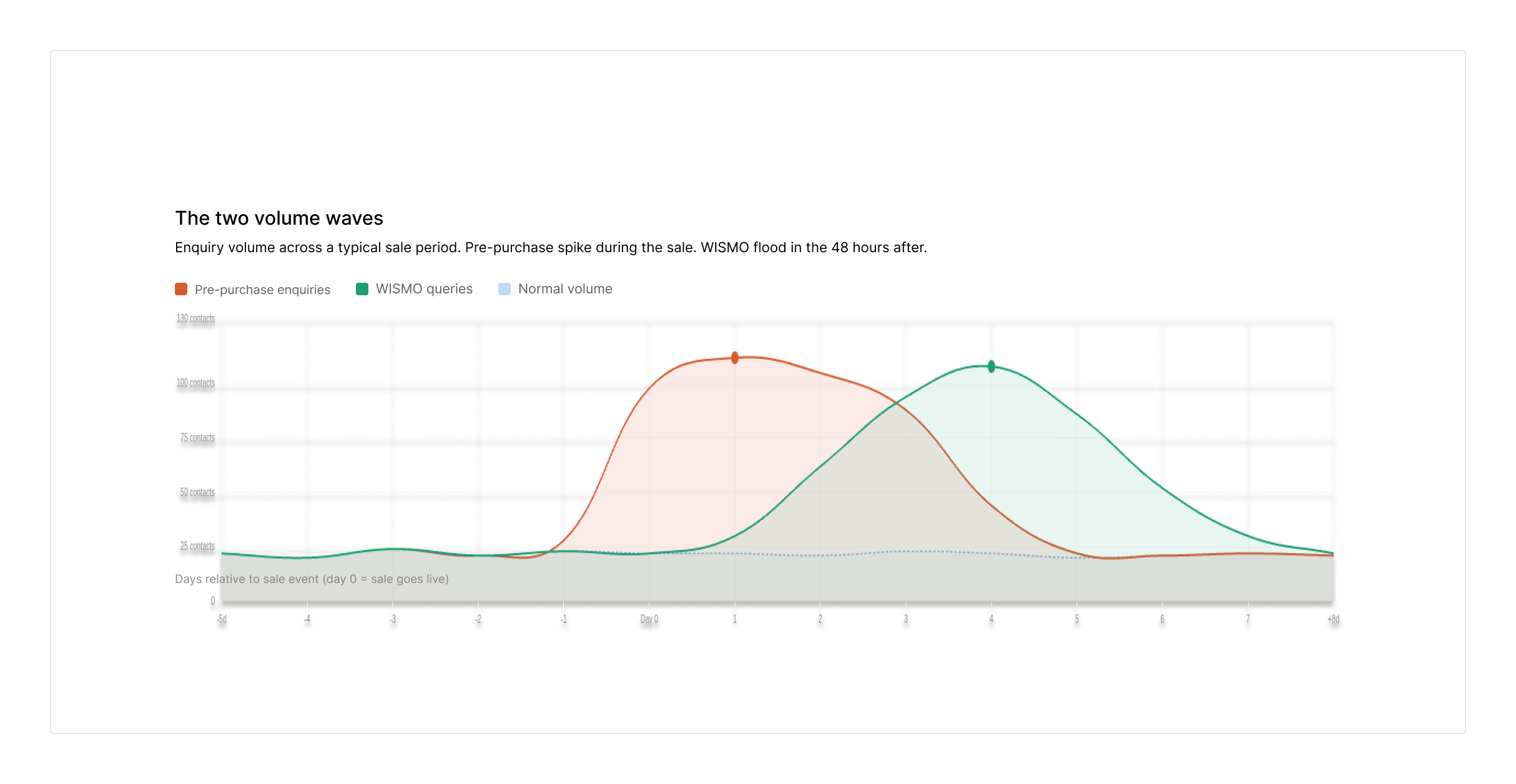
These two waves are separate problems with the same root cause: both are high-volume, repetitive, and entirely predictable. And both land on the same team at the same time.
Why human teams can’t absorb peak volume
The maths don’t work. Scaling a support team for peak period volume means carrying capacity you can’t use the other 49 weeks of the year. Temporary staff take time to train, make mistakes on product-specific questions, and create inconsistency in how customers are handled at the exact moment consistency matters most.
The real cost isn’t payroll — it’s the questions that fall through. A team at capacity starts triaging. The quick questions get answered. The complex ones wait. Pre-purchase questions, which are time-sensitive by nature, are especially vulnerable: a customer asking about sizing at peak buying intent won’t wait three hours for a reply. They’ll make a decision without the answer, and the probability of that decision being ‘buy’ is lower than it was when they sent the message.
Post-purchase WISMO is different in character but identical in cost. These customers aren’t at risk of leaving — they’ve already bought. But unresolved WISMO generates returns, chargebacks, and negative reviews. It creates avoidable cost at exactly the point when the team is least available to handle it.
The alternative to scaling headcount isn’t doing less. It’s automating the repetitive layer — the questions that have a defined answer, every time — so the human team handles the escalations that actually require human judgment.
What SpeedGrowth does during a peak period
SpeedGrowth deploys a configured agent that handles both volume waves automatically — without adding headcount and without a human in the loop for every reply.
Pre-purchase questions — sizing, delivery estimates, return policy, stock availability — are answered instantly, in the brand’s voice, from the knowledge base the brand configures. The agent doesn’t triage. It doesn’t have a queue. Every question gets a response the moment it arrives, regardless of what else is happening.
Post-purchase WISMO is handled the same way. Order status queries, shipping updates, policy questions — the agent answers them accurately, consistently, and at any volume the period generates. The support team sees escalations: the exceptions, the edge cases, the situations that genuinely require a person. The repetitive layer is handled.
The setup is straightforward — no developer, no technical knowledge required. Brands configure the agent from a dashboard: upload the knowledge base, set the agent’s behaviour, and deploy to the channels customers are using. Website widget, WhatsApp, Instagram DMs, Facebook Messenger — the same agent, across every channel, from one place.
The result isn’t a better support team. It’s a different model: the human team focused on the work only humans can do, the agent handling the volume that doesn’t require them.
The next peak period will generate the same two waves it always does. The question isn’t whether the volume will arrive — it’s whether the system handling it will be the same one that cost you revenue last time.
What’s the one part of your peak period support workflow that runs on repetition — and shouldn’t have to?
Request early access → https://speedgrowth.ai/